
Table of Contents
Most people don’t think about carpet cleaning until the carpet already smells like something. A dog had an accident, the kids tracked in red clay from the backyard for the third time this month, or you’re getting ready to sell the house and the inspector is going to notice that traffic pattern down the hallway. At that point you go looking for someone to fix it, and Texas has no shortage of companies willing to take your money — the problem is figuring out which ones actually know what they’re doing.
I’ve talked to enough homeowners around Houston and Austin to know the complaints are almost always the same: a crew showed up, ran a machine over the carpet for twenty minutes, left it soaking wet in July humidity, and the smell came right back a week later. That’s not really a carpet cleaning failure. It’s a hiring failure. The equipment and training exist to do this job well — the trick is knowing enough to tell the difference before you sign anything.
Carpet cleaning contractors in Texas generally charge somewhere between $0.25 and $0.75 per square foot, which works out to roughly $120–$300 for an average three-bedroom home. Hot water extraction — what most people just call steam cleaning — is what carpet manufacturers and the IICRC actually recommend for a deep clean, because it flushes soil and allergens out of the fiber instead of just pushing dirt around on the surface. If a quote sounds too cheap for that square footage, it usually is, and you’ll find out why once the crew is already in your living room.
What “carpet cleaning contractor” actually means
Technically, it’s anyone running a business that cleans carpet for a living — but that covers a huge range, from a solo guy with a truck-mounted extraction unit and fifteen years of experience, to a franchise crew working off a script, to someone who bought a portable machine last month and put up a Facebook ad. Texas doesn’t license this trade at the state level, so the title alone tells you nothing. What separates a real contractor from someone winging it is training (IICRC certification is the closest thing to an industry standard), insurance, and whether they actually know how carpet fiber and Texas humidity interact.
The methods, and why they’re not interchangeable
There are basically four approaches you’ll run into, and contractors don’t always tell you upfront which one they’re using — “steam cleaning” gets thrown around loosely, so it’s worth asking directly.
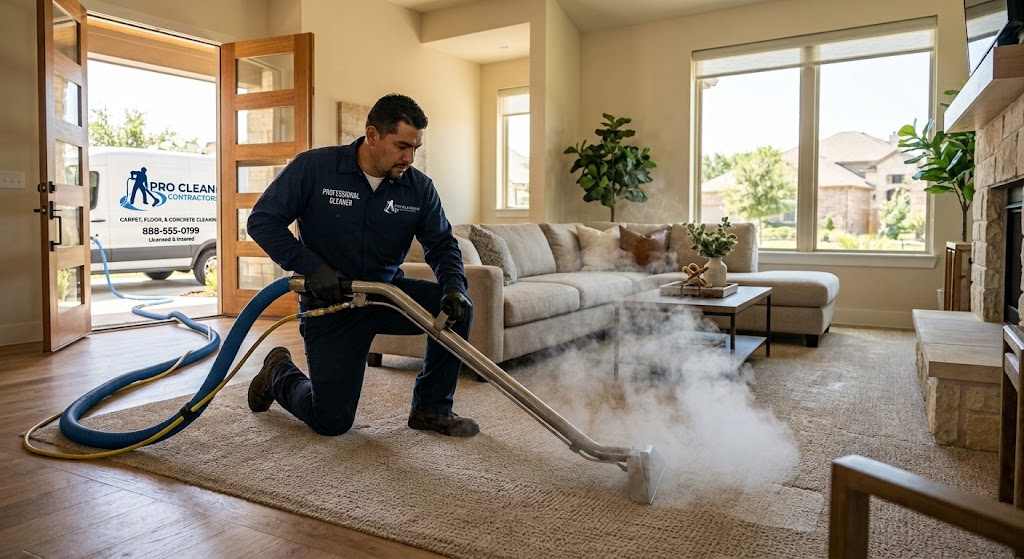
Hot water extraction is the deep-clean standard. Hot water and cleaning solution get injected into the carpet under pressure, then immediately extracted back out along with the loosened soil. It’s the most thorough method, but it also leaves carpet damp for six to twelve hours, which matters a lot if you live somewhere humid like Corpus Christi or Beaumont.
Dry compound cleaning uses an absorbent compound worked into the carpet with a machine, then vacuumed out. It’s fast — carpet is usually walkable within an hour or two — but it doesn’t reach soil buried deep in the pile the way extraction does. Offices like it because they can’t shut down for half a day.
Encapsulation works on a similar low-moisture principle, using a polymer that crystallizes around dirt particles so they can be vacuumed away later. It’s decent for maintenance between deep cleans, but it’s not a substitute for one.
Bonnet cleaning is the quick surface pass you sometimes see in hotels — a spinning pad soaks up surface grime fast, but overused it can actually push soil deeper into the carpet over time rather than removing it.
For an average home that gets real foot traffic, hot water extraction once a year is what most experienced technicians will tell you to do, with a lighter method in between if you’ve got pets or kids.
| Method | Best for | Dry time | Typical cost |
|---|---|---|---|
| Hot water extraction | Deep soil, pet dander, allergens | 6–12 hrs | $0.30–$0.75/sq ft |
| Dry compound | Offices, quick turnaround | 1–2 hrs | $0.25–$0.50/sq ft |
| Encapsulation | Maintenance between deep cleans | 1–3 hrs | $0.20–$0.45/sq ft |
| Bonnet | Surface refresh only | 1–2 hrs | $0.20–$0.40/sq ft |
What it actually costs
Pricing swings a bit depending on where you are in the state — Austin and Houston tend to run a little higher than smaller metros, mostly because of labor costs. As a rough guide:
- Per room, up to about 200 square feet: $40–$75
- Whole house, three bedrooms plus living areas: $150–$350
- Pet stain or odor treatment: $30–$100 per affected area, on top of the base price
- Stairs: $2–$5 per step
Watch out for the “$99 whole house” ads. They’re almost never actually pricing your whole house — they’re pricing whatever square footage lets them hit that number, and the rest gets added on once the crew is standing in your hallway telling you the carpet “really needs” the deep treatment. It’s a sales tactic, not a discount.
Licensing isn’t the safeguard people assume it is
Because Texas doesn’t require a specific state license for carpet cleaning, you can’t rely on “are they licensed” the way you might for an electrician or plumber. What you can check:
- IICRC certification — this is the trade’s actual training standard, covering fiber types, chemistry, and drying technique
- General liability insurance — covers your home if a machine damages flooring or furniture
- Workers’ comp, if they’re sending more than one person
- Local business registration, which at least confirms they’re operating as a real business and not off Craigslist
Ask for proof before you book, not after something goes wrong. A legitimate contractor won’t blink at the question.
What to actually ask before you book
Get quotes from at least two or three companies for the same square footage — the spread in prices you get back tells you a lot on its own. Ask which method they’re using and why, given your carpet’s fiber. Ask how long it’ll take to dry, especially if it’s July in Houston, because a company that doesn’t have an answer for that probably doesn’t have a real drying plan either. Read the reviews that aren’t in the first three — the pattern usually shows up further down, in complaints about upselling or a rushed job. And get the estimate in writing, including what counts as an “extra,” so you’re not negotiating a surprise charge with someone already in your house.
Sites like Carpet Cleaners Contractors Texas companies by service area along with their certifications, which is a faster starting point than working through a dozen open browser tabs.
Where people go wrong
The biggest mistake is picking based on price alone without knowing what’s included. The second is not asking about drying time and then walking on damp carpet an hour later, which flattens the pile and can trap moisture underneath. The third — and this one’s less obvious — is assuming a bad smell will come out with regular carpet cleaning when it’s actually in the padding or subfloor. Pet urine in particular soaks past the fiber; surface cleaning alone often doesn’t touch it, and you need an enzyme treatment or, in bad cases, a padding swap.
On local forums and neighborhood Facebook groups, the advice that comes up again and again is pretty consistent: ask exactly which method is being used instead of accepting “steam clean” at face value, don’t pay in full before the work is inspected, and book before allergy season hits rather than after everyone’s already sneezing.
How often should carpet actually get professionally cleaned?
Once a year for a typical household is the standard advice. If you’ve got pets, kids, or allergies in the house, every six months holds up better.
Does steam cleaning damage carpet?
Not when it’s done right. The damage people run into almost always comes from over-wetting or poor drying, not the extraction process itself.
Can cleaning fully get rid of pet odor?
Sometimes, but not always — if urine has soaked into the padding, surface cleaning won’t reach it. That needs an enzyme treatment or, in the worst cases, replacing the padding underneath.
Do I need to move furniture first?
Clear the small stuff off the floor yourself. Most crews will move standard furniture as part of the job, but heavy or fragile pieces — pianos, china cabinets — usually aren’t covered under their insurance unless you’ve talked about it ahead of time.
Why does carpet sometimes look dirtier right after it’s cleaned?
That’s usually wicking — soil sitting deep in the padding rises to the surface as the carpet dries. It’s more common when the extraction wasn’t thorough, and it usually clears up with a light vacuum once everything’s fully dry.
Expect to pay $0.25–$0.75 per square foot for a real carpet cleaning job in Texas. Hot water extraction is the method worth paying for if you want an actual deep clean, not just a surface pass. Since the state doesn’t license this trade, IICRC certification and proof of insurance are what you check instead — and a couple of direct questions before you book will save you from the upsell conversation that happens once the crew’s already unloading the truck.